Ownership · · 6 min read
White-Label Community Platform: Your Brand, Your Domain
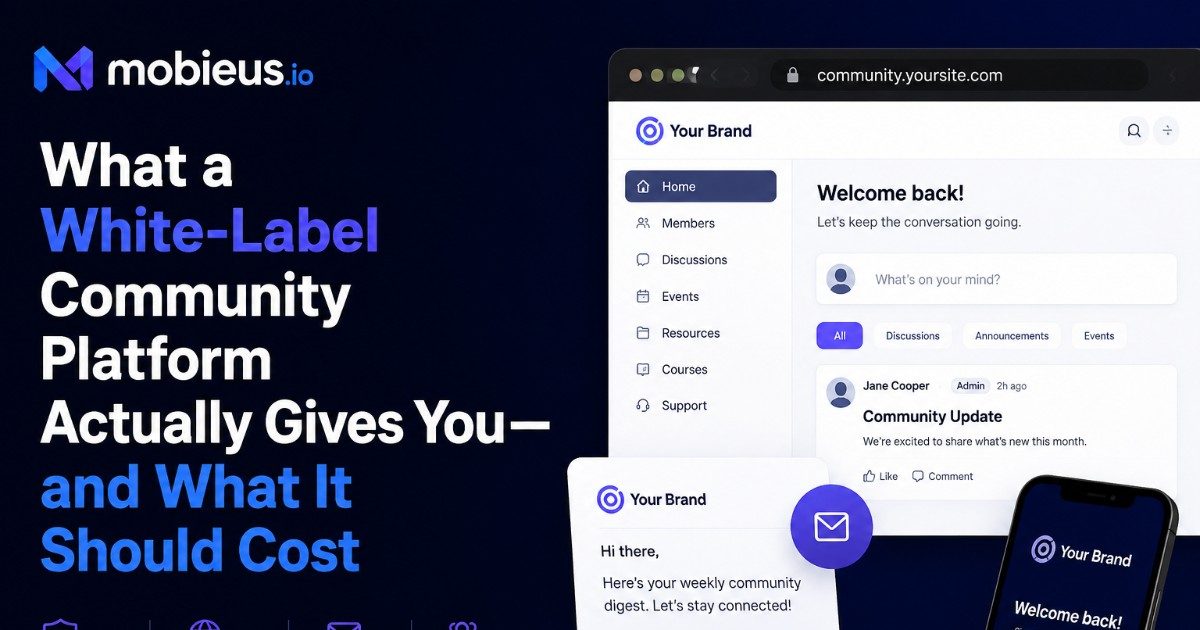
What a White-Label Community Platform Actually Gives You — and What It Should Cost
You have seen the badge. A community platform stamps "Powered by [their name]" across the space you built, then asks for $50 to $200 a month to take it off. Until you pay, your community doubles as an advertisement for someone else's software. That one badge is the clearest test of what white-label really means on a given platform, and most platforms fail it quietly by turning the thing you actually want into the thing you pay extra for. If you are evaluating a white-label community platform, the badge is where the question starts. It is not where it ends.
What a white-label community platform actually means
White-label means the community carries your identity, not the vendor's. Your domain, your logo, your colors, your name, your email. The member experience reads as your brand from the first screen to the last line of the footer. Done properly, a member could use the community for months without ever learning which software runs underneath.
That bar is higher than it sounds. Plenty of platforms let you upload a logo and pick an accent color, then undercut the effect with their badge in the footer, their name on the login screen, and their domain in every notification email. Cosmetic branding is not the same as a white-label community platform. The real question is whether anything a member sees still points back to the vendor.
The "Powered by" badge tax
The badge is rarely an accident. For most platforms it is a growth lever: free and lower-tier communities advertise the vendor to every visitor, and removing that advertisement becomes a paid upgrade. Some platforms charge more to remove the badge than they charge for core functionality. The model works because operators feel the badge as a small monthly annoyance rather than a structural problem, so they pay rather than switch.
For a hobby group with no commercial stake, the badge is harmless. For a business whose brand is the product, it is a leak. Every member who notices it learns that the community is rented, not owned. Compare how platforms like Circle, Mighty Networks, and Skool handle white-labeling, what tier it requires, and what it costs to remove their attribution, because the answer varies widely and it tells you how each platform really thinks about whose brand the community belongs to. A short way to read the whole category is to put the platforms side by side on this one question.
What real white-label control looks like
Beyond the badge, white-label is a set of surfaces that either carry your brand or do not. A strong platform gets all of them, not just the easy ones.
Your own domain. The community should run at community.yoursite.com with TLS handled for you, not parked on a vendor subdomain that announces the software in the URL. A custom domain is the foundation everything else sits on, because it is the one surface members see in every link they share.
Brand identity on every surface. One logo upload should reach the header, the login screen, email templates, and the mobile bookmark icon without you placing the same file a dozen times. A color system should propagate across the whole interface at once, so buttons, links, navigation, and states all shift together rather than leaving half-themed corners.
Email from your address. Notifications are where weak white-labeling shows. If reset emails and digests arrive from the vendor's domain, members learn the software's name in their inbox. Real ownership sends mail from your sender and reply-to address, so members reply to you.
Connected products that stay on-brand. The moment a platform bundles a help desk or a learning system, brand consistency gets harder. If a member moves from your forums to a support ticket or a course and the look changes, the white-label illusion breaks. The stronger model carries one theme across every connected product so there is no visible seam.
Data and search presence. White-label extends past the visible UI into how the community shows up elsewhere. Your meta descriptions, your social preview images, and your structured data mean search results and shared links present your brand, not the platform's. That overlaps with broader data ownership, and it is part of the same question: whose asset is this, really?
What white-labeling should cost
This is where platforms diverge most, and where the pricing logic gives away the philosophy. If a platform treats your brand as a premium feature, removal is expensive because the badge is doing marketing work the vendor does not want to lose. If a platform treats your brand as the default, removal is cheap or unnecessary because there was almost nothing to remove.
Mobieus is the clearest current example of the second approach. Every plan brands the community as yours by default, which leaves a single "Powered by mobieus.io" line in the footer as the only vendor trace anywhere a member can see. The optional add-on that removes even that line runs $30 a month, against the $50 to $200 common elsewhere, with no four-figure enterprise contract attached. The number matters less than what it signals: the brand was never the upsell. You can see how that lands across tiers, but the shape of the pricing is the point.
Who needs white-label most
Not every community needs this. A volunteer group or a casual interest space loses nothing to a vendor badge. The case gets sharp the moment the community is tied to a business.
Creators and coaches live or die on personal brand, and a "Powered by" line on a paid community quietly undercuts the premium they are charging for. Agencies and consultants have an even harder requirement: they need to ship a community to each client under that client's brand, with no third-party attribution to explain away in the handoff. And organizations running internal or partner communities need the space to carry corporate identity, which is often what gets IT and compliance to approve a new tool at all.
The better question to ask
The badge is the surface. The real question underneath it is whether a platform is built so your brand is the default and the vendor disappears, or built so your brand is an upgrade you rent back one month at a time. A platform can look polished and still answer that question the wrong way.
So when you evaluate a white-label community platform, do not stop at "can I remove the badge." Ask what it costs, what tier it takes, how many surfaces it actually covers, and what still points back to the vendor after you have paid. The platform that makes ownership the starting point, rather than the premium, is the one that will still feel like yours once the community matters.