Product · · 7 min read
Who Owns Your Community's SEO? On Most Platforms, It Isn't You
You probably chose your community platform for the things you could see in the demo — the feeds, the courses, the payments, the way it looked on the screen. SEO almost never makes the shortlist. Then a few months in, the question shows up anyway: why doesn't Google seem to know your community exists, why is your analytics one stray line of code someone pasted into a box, and why can't you tell which threads are actually bringing people in? None of that was an accident. Your platform made those calls for you the day you signed up, and most of them make the calls badly.
Community SEO is one of the most undervalued assets in this whole category, and it is also one of the easiest things for a platform to quietly take off the table before you notice it was ever an option.
Your community is content, whether you treat it that way or not
A busy community produces exactly the kind of content search engines were built to reward: real questions, real answers, threads that go deep on a narrow topic, guides that get refined over time. Every public thread is a potential landing page for someone typing that exact question into Google. A year of active discussion can quietly become hundreds of indexable pages, each one a doorway into your community.
That only pays off if three things are true. Search engines have to be allowed in. You have to be able to measure what happens once they arrive. And the authority all that content earns has to accrue to your brand and domain, not the platform's. Most community tools get at least one of those three wrong, and some get all three wrong by default.
The walled gardens: invisible on purpose
Start with the platforms that aren't even in the running. A Facebook Group or a Discord server keeps your discussions behind a login. Google can't crawl what it can't reach, so none of that content exists as far as search is concerned. You might have ten thousand members and a thousand great threads, and your organic search footprint from all of it is zero.
For a casual hangout, that's fine. For anything you're trying to grow, it's a slow leak: every valuable answer your members write becomes a private asset for the platform instead of a public asset for you. You're renting reach and building nothing that compounds.
The hosted platforms: better, but you're a tenant on their domain
Platforms like Circle, Skool, and Mighty Networks are a real step up, because their content can be public and indexed. Skool communities, for example, get crawled, and individual posts can rank. But "indexed" and "owned" are not the same thing, and the gap between them is where the trouble lives.
First, the domain. By default these platforms park you on theirs — a skool.com/your-community path, a Circle subdomain — and put a custom domain behind a higher-priced tier. Skool's custom domain sits on its premium plan; Circle's lands on Pro and up. Until you pay to move, every bit of search authority your members generate is compounding on the platform's domain, not yours. Leave someday and a lot of that equity stays behind.
Second, analytics. The standard model is a box where you paste a code snippet into the page head — Circle, for instance, has you drop a Google Analytics or Facebook Pixel tag in yourself. It works, but it's do-it-yourself, client-side, usually one tag at a time, and validated by nothing. Client-side tags get blocked by extensions, fire after the page paints, and break quietly when you fat-finger a character. You're doing the platform's analytics engineering for it, and absorbing the fragility.
Third, and this is the part almost nobody exposes: the deeper SEO surface. A real Search Console verification, a sitemap built from live content, the ability to ping search engines when something new ships, control over your robots.txt, an llms.txt for the AI crawlers — on most community platforms, none of that is a setting you can touch. It's just decided for you, invisibly, and usually conservatively.
What owning your community SEO actually takes
Strip away the marketing and "owning your SEO" comes down to a specific control surface. A platform that genuinely hands it to you lets you do all of this:
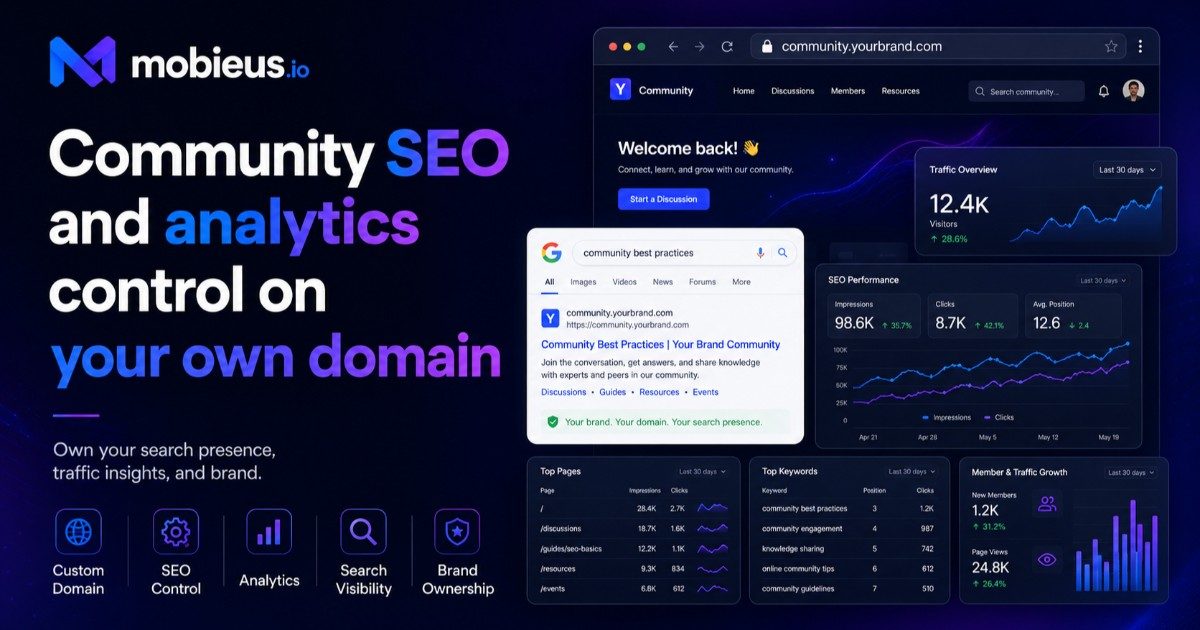
Run on your own domain with TLS handled for you, so every link members share carries your brand. Drop in your own analytics — GA4, Plausible, whatever your team actually uses, ideally more than one and injected server-side so blockers and timing don't corrupt the data. Verify with Google and Bing in a couple of clicks instead of fighting the platform to inject a meta tag. Serve a real sitemap generated from your live threads, guides, and events, with accurate last-modified dates, and ping the search engines through something like IndexNow so new content gets noticed in seconds instead of days. Control your own robots.txt. Publish an llms.txt describing your site for language models. And make a deliberate decision about AI crawlers rather than inheriting the platform's.
That's the bar. It's higher than "we have analytics," and it's the bar most community software was never built to clear.
How Mobieus approaches it
This is the part Mobieus treats as table stakes rather than an enterprise upsell. Every tenant gets the full surface from its own admin: pick from GA4, Google Tag Manager, Plausible, Fathom, or PostHog and the tags are injected server-side on every page, more than one at a time if you want GA4 for marketing and Plausible for yourself. Paste your Search Console and Bing tokens once and the verification tags go into every page head. A robots.txt editor ships with a sensible default that allows search bots and blocks your internal paths. An llms.txt is auto-generated and editable. The sitemap is built from live data with real timestamps, and one button force-refreshes it and pings IndexNow. The full breakdown of how that's built is worth reading if you want the technical detail, including why server-side injection beats the client-side snippet box on both reliability and accuracy.
The pattern underneath it is the same one that runs through everything Mobieus does: if a setting is really a brand decision, the brand owner should hold the knob, not the vendor.
The AI-crawler question most platforms won't let you answer
Here's a decision you almost certainly never got to make. Should GPTBot, ClaudeBot, and the rest of the named AI crawlers be allowed to read your members' threads? On most platforms the answer is whatever the platform decided, and you'll never see the switch. Some operators want their content in AI answers because it drives discovery. Others promised members their discussions wouldn't end up in a training corpus. Both are legitimate, and they point in opposite directions.
Mobieus surfaces it as a plain toggle that writes the named-AI blocks into robots.txt and sets the matching headers. It's also honest about the ceiling: no robots-honoring directive stops a scraper that ignores the rules. But it covers the well-behaved crawlers, and at least the call is yours to make.
Who should care, and who really shouldn't
If your community is a hobby, none of this matters and you should pick whatever feels nice to use. The calculus flips the moment the community is tied to a business. Creators and coaches live on organic discovery — every thread that ranks is a member you didn't pay an ad network to reach. Associations and organizations need the community to be a durable, owned asset that survives staff turnover and platform policy changes, which means the search presence has to live on their domain and under their control, not the vendor's. For both, weak community SEO isn't a missing feature. It's a permanent tax on growth.
The better question to ask before you commit
When you're evaluating a community platform, the demo will sell you on the parts you can see. The SEO and analytics surface is the part you can't, and it's the part that decides whether your community becomes a search asset you own or a stream of content that builds someone else's domain. So ask directly, before you sign: Can I run on my own domain? Can I bring my own analytics? Can I verify in Search Console, control my sitemap and robots.txt, and decide for myself about AI crawlers?
If the platform can't answer yes to most of that, it can still be a fine place to launch. Just know that you're building your search presence on rented land, and the longer the community lasts, the more that arrangement costs you. You can always compare how the platforms actually stack up on this before you decide whose domain your hard-won content is going to live on.